Artisan No-Knead Italian Bread with Maximum Crust Development
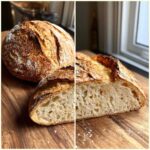
This recipe produces a rustic Italian loaf with a very crisp, crackly exterior achieved through high hydration and steam injection during baking.
- Prep Time: 15 min
- Cook Time: 50 min
- Total Time: 19 hours 5 min
- Yield: 1 large loaf
- Category: Bread
- Method: Baking
- Cuisine: Italian
- Diet: Vegetarian
Ingredients
Scale
- 3 cups Bread Flour (or Italian ’00’ flour)
- 1 1/2 cups Warm Water (about 105°F)
- 1 teaspoon Instant Dry Yeast
- 1 1/2 teaspoons Fine Sea Salt
- 1/4 cup Semolina flour (for dusting)
Instructions
- Combine the warm water and yeast in a large bowl. Let stand for 5 minutes until slightly foamy.
- Add the flour and salt to the yeast mixture. Stir with a wooden spoon until a shaggy, wet dough forms. Do not knead.
- Cover the bowl tightly with plastic wrap. Let the dough rest at room temperature for 12 to 18 hours. The dough will become bubbly and increase in volume.
- Lightly dust a work surface with semolina flour. Gently scrape the dough out of the bowl onto the surface.
- Fold the dough over itself a few times to create a rough round shape. Do not punch down or overwork the dough.
- Place the dough onto a piece of parchment paper. Cover loosely with a clean kitchen towel and let it proof for 30 minutes.
- Preheat your oven to 475°F (245°C) with a cast iron Dutch oven or a sturdy baking pan placed inside for at least 30 minutes to get it very hot.
- Carefully remove the hot Dutch oven (or pan). Use the parchment paper to lower the dough into the hot vessel.
- For maximum crispness, place a shallow metal pan on the bottom rack of the oven and pour 1 cup of boiling water into it immediately before closing the door to create steam.
- Bake covered for 30 minutes.
- Remove the lid (or carefully pour out the water from the bottom pan). Reduce the oven temperature to 450°F (230°C).
- Bake uncovered for an additional 15 to 20 minutes, or until the crust is deep golden brown and sounds hollow when tapped.
- Transfer the loaf to a wire rack to cool completely before slicing.
Notes
- High hydration (wet dough) is key to an open crumb and a thin, crisp crust.
- Steam is necessary for the first half of the bake; it keeps the crust soft long enough for the bread to expand fully (oven spring) before hardening into a crisp shell.
- If you do not have a Dutch oven, bake the loaf directly on a preheated pizza stone and place ice cubes in a hot pan underneath to generate steam.
Nutrition
- Serving Size: 1 slice
- Calories: 180
- Sugar: 0.5
- Sodium: 350
- Fat: 0.5
- Saturated Fat: 0.1
- Unsaturated Fat: 0.4
- Trans Fat: 0
- Carbohydrates: 38
- Fiber: 2
- Protein: 6
- Cholesterol: 0